Fake Bose QuietComfort: How to Spot Counterfeit Headphones in the UK
You spot a pair of Bose QuietComfort 45 headphones online for £120 instead of the usual £300, the listing says “brand new sealed” and the seller has decent feedback, so you order them. When they arrive, something feels wrong. The box is lighter than expected, the noise cancellation barely muffles background chatter, and the hinges creak when you fold them. If that sounds familiar, you may have bought fake Bose headphones. We’ve put together this guide to help UK buyers spot counterfeit headphones before and after purchase, verify genuine products, and know exactly what to do if they’ve been caught out.
Why Fake Bose QuietComfort Headphones Are Flooding the UK Market
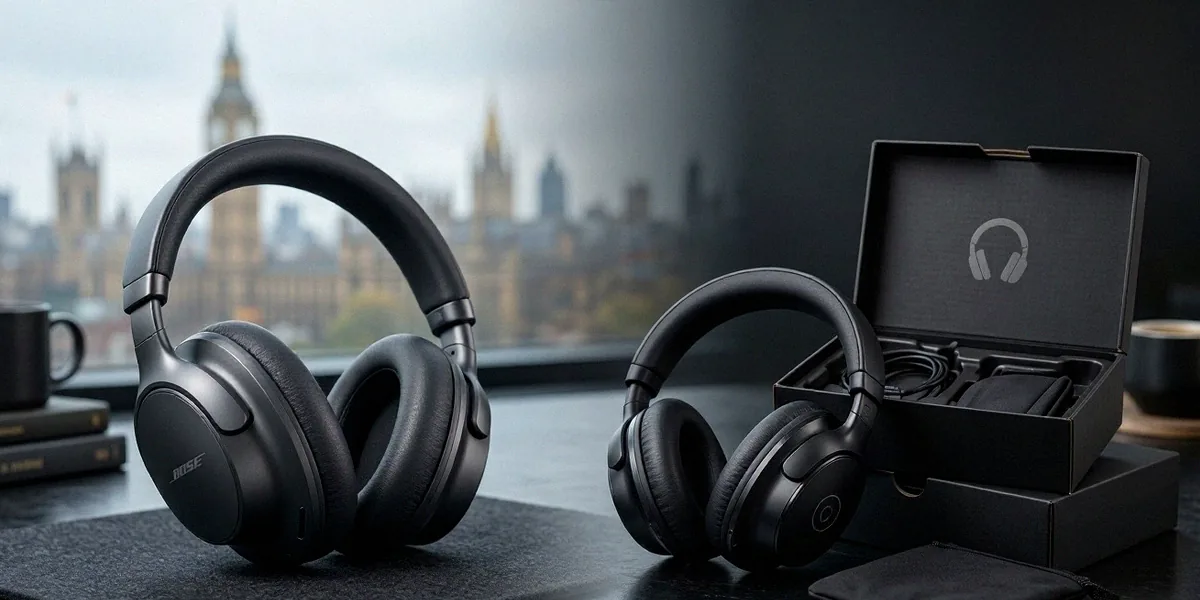
Counterfeit earbuds and headphones have become a serious problem across the UK. Online marketplaces, social media ads, and even car boot sales are saturated with convincing-looking copies, and Bose is one of the most targeted brands. The QuietComfort 35, QuietComfort 45, and QuietComfort Ultra are the models most commonly counterfeited, largely because their popularity makes them easy to sell on quickly at a “bargain” price.
Counterfeiters have become smarter too. Many now copy the outer shell almost exactly, which means buyers can’t rely on appearance alone. That’s why we always recommend checking serial numbers, packaging details, and sound performance rather than trusting a photo.
The lure of too-good-to-be-true deals
The single biggest warning sign is price. If a pair of Bose QuietComfort Ultra headphones is listed at 50–70% below retail, something is wrong. Legitimate UK retailers rarely discount current models that heavily, and authorised sellers don’t sell “new sealed” stock through random social media accounts.
Scammers exploit urgency too, using phrases like “last one”, “clearance”, or “unwanted gift” to rush buyers into paying before they can think it through. We’ve seen countless cases where buyers paid via bank transfer and then found the seller had vanished.
Common UK sources: marketplaces, social media, and car boot sales
In the UK, fake headphones typically turn up in a handful of places:
- Third-party sellers on large online marketplaces, often with stock photos and vague descriptions
- Facebook Marketplace, Instagram, and TikTok ads offering “authentic” Bose at unrealistic prices
- Car boot sales and pop-up market stalls, where there’s no receipt and no comeback
- Classified sites like Gumtree, where sellers insist on cash and meet-ups
None of these channels are automatically fraudulent, but they carry far higher risk than buying from a Bose-approved UK retailer.
Packaging Clues: What Fake Bose Boxes Get Wrong
Packaging is often where counterfeits fall apart. Genuine Bose packaging includes a holographic authentication sticker and a serial number that matches the product inside. Fakes usually miss at least one of these elements, or include a sticker that looks printed rather than reflective.
Logo and typography errors
Look closely at the Bose logo on the box. On genuine packaging, the lettering is crisp, evenly spaced, and correctly sized. On fakes, you’ll often see blurry edges, stretched fonts, or slightly wrong proportions. Grammar and spelling mistakes on the box or manual are another giveaway — genuine Bose packaging is professionally printed and proofread.
Missing or fake authentication stickers
Authentic Bose boxes carry a holographic sticker that shifts colour when tilted, plus a serial number label. If the sticker looks flat, peels easily, or is missing altogether, treat it as a red flag. Some counterfeiters print their own “authentication” stickers, but they usually lack the reflective quality and detail of the real thing.
Accessory quality: cables, cases, and manuals
Open the box and inspect the extras. Genuine Bose accessories feel substantial: the carry case has sturdy stitching, the cables are thick and well-moulded, and the manual is printed on quality paper. Counterfeit kits often include thin cables, flimsy cases with loose threads, and manuals with faded print or broken English.
Serial Numbers and Authentication: How to Verify Your Bose
The serial number is the most reliable way to confirm whether your Bose headphones are genuine. Every authentic pair has a unique serial that Bose can verify, and counterfeiters rarely get this right.
Where to locate the serial number on real Bose headphones
On genuine Bose QuietComfort models, the serial number is printed inside the earcup, usually hidden beneath the removable cushion. You may need to gently peel back the padding to find it. The same number should appear on the packaging and, where applicable, in the Bose Music app once paired.
Using Bose’s online verification tool
Bose provides an official verification tool on its website where you can enter the serial number and confirm authenticity. If the number isn’t recognised, or if the model shown doesn’t match your headphones, you’re almost certainly dealing with a fake. We recommend doing this immediately after purchase, while you’re still within the returns window.
Red flags: duplicated or missing serials
Counterfeiters often reuse the same serial number across thousands of units. If you search a serial online and find other buyers reporting the identical number, that’s a clear sign of duplication. A missing serial, a serial that doesn’t match the box, or one that Bose’s tool rejects are all grounds for an immediate refund request.
Sound and Build Quality: The Clues You Can Hear and Feel
Once you’ve got the headphones in hand, the performance usually gives the game away. Fake Bose headphones often have poor noise cancellation, muddy or distorted bass, and microphones that make you sound distant on calls. Build quality is another giveaway.
Noise cancellation and audio performance tests
Genuine QuietComfort headphones dramatically reduce low-frequency noise like engine hum or air conditioning. Fakes usually just muffle sound slightly. Play a familiar track and listen for clarity — real Bose audio is balanced, while counterfeits often sound hollow or overly bass-heavy.
Materials, weight, and hinge movement
Authentic Bose headphones feel solid but not heavy, with smooth hinge action and soft, well-fitted earpads. Fakes use cheaper plastic that flexes under pressure, hinges that wobble or creak, and earpads that feel thin or irritate the ears after a short time. Compare the weight against the official spec — counterfeits are often noticeably lighter.
Microphone and connectivity issues
Test the microphone on a call or voice recording. Genuine Bose mics pick up your voice clearly; fakes often sound tinny or cut out. Bluetooth connectivity is another weak point — counterfeits may drop connection, refuse to pair with the Bose Music app, or fail firmware updates entirely.
What to Do If You’ve Bought Fake Bose Headphones in the UK
If you’ve discovered your headphones are counterfeit, don’t write it off as a loss. UK consumers have real protections, and there are official routes for reporting sellers.
Reporting to Trading Standards and Citizens Advice
Trading Standards and Citizens Advice are the main UK bodies for reporting counterfeit goods. You can contact Citizens Advice, who will pass details to Trading Standards in your area. Reporting helps shut down repeat offenders and protects other buyers.
Your rights under the Consumer Rights Act 2015
The Consumer Rights Act 2015 gives UK buyers the right to a refund for fake goods. If you bought from a UK trader, you’re entitled to your money back because the item wasn’t as described. Contact the retailer in writing, state that the goods are counterfeit, and request a full refund. If they refuse, you can escalate through the platform or take the matter to small claims court.
How to avoid future counterfeits: buy from authorised UK retailers
For online purchases where the seller can’t be traced, you can also report to Action Fraud. To avoid future problems:
- Buy only from Bose’s official website or authorised UK retailers
- Check serial numbers using Bose’s verification tool as soon as your order arrives
- Pay by credit or debit card so you have chargeback protection
- Be sceptical of any deal priced far below retail
Staying vigilant, checking serial numbers, and sticking to reputable UK sellers are the surest ways to enjoy genuine Bose QuietComfort headphones without the disappointment of discovering you’ve bought a fake.
FAQ
How can I tell if Bose QuietComfort headphones are fake?
Check the serial number inside the earcup against Bose’s official verification tool, inspect the packaging for the holographic authentication sticker, and test noise cancellation and build quality. Fakes usually fail at least one of these checks.
Are fake Bose headphones sold on major UK marketplaces?
Yes. Third-party sellers on large marketplaces frequently list counterfeit Bose models, particularly the QuietComfort 35, 45, and Ultra. Always check whether the seller is an authorised Bose retailer.
Can I get a refund for counterfeit headphones in the UK?
Yes. Under the Consumer Rights Act 2015, goods must be as described, so counterfeit items qualify for a refund. Contact the retailer first, then escalate to the platform or small claims court if needed.
Where do I report fake headphones in the UK?
Report to Trading Standards via Citizens Advice. If you purchased online and can’t identify the seller, you can also report the matter to Action Fraud.
Do fake Bose headphones have working noise cancellation?
Rarely. Counterfeit Bose models typically offer weak or non-existent noise cancellation, distorted audio, and poor microphone quality compared with genuine units.